Friday, December 10, 2010

iPad 2 Has Two Cameras, Better Display, Coming Early Next Year

Coming Early Next Year

Reuters: iPad 2 Has Two Cameras, Better Display, Coming Early Next Year

We've heard these rumors in bits and pieces before, but today Reuters reports with conviction that the next will have front and rear-facing cameras, a higher res display, and will start production in the early months of next year.
Reuters cites multiple supplier sources, two of whom said that production would begin soon for iPad 2. The next generation of Apple's tablet is expected to be thinner and lighter, with an improved screen resolution that will can hopefully keep up with the iPhone 4's retina display. Most importantly, it will add a front-facing camera to allow for video chat.
It's everything you would expect, given Apple's track record of yearly product updates. But the more confirmation I get about an iPad 2 FaceTime camera, the more I start saving up my pennies.

Source: gizodo

Thursday, December 9, 2010

iPad 2 on track for April launch

A report in DigiTimes early Tuesday that Foxconn has been ordered to begin shipping the next generation iPad within the next 100 days -- with initial shipments to reach 400,000 to 600,000 units -- sparked a flurry of headlines suggesting that Apple (AAPL) had shortened its production cycle and might start selling the iPad 2 before the end of February.
But shipping from a Chinese factory is not the same as selling in a U.S. Apple Store, as the rest of the DigiTimes item makes clear.
"Apple currently has no plans to stop production" of the original iPad, DigiTimes reports. Its sources "expect [iPad 1] shipments to drop significantly after the end of the January as the company begins to digest the inventory across the rest of the first quarter and then launch the iPad 2 in April." (emphasis ours)

The report does highlight a discrepancy between the number of iPads Foxconn reportedly shipped last quarter (6 million) and the number Apple reported selling (4.19 million). That suggests that Apple went into the current quarter with nearly 1.8 million iPads in inventory.
"[DigiTimes'] sources forecast that Apple will still place about 1.6-1.8 million units of orders in January, but will start to reduce order volumes in February to allow the remaining inventory to last until the end of March."
Which puts Apple on schedule to release the iPad 2 in early April, exactly one year after it launched the iPad 1.

source:  cnn

Monday, December 6, 2010

Why Did NASA Create a Material Ten Times Blacker than the Blackest Black Paint?


Why Did NASA Create a Material Ten Times Blacker than the Blackest Black Paint?NASA Goddard Space Flight Center scientists have created a new material that is ten times blacker than the blackest black paint in the world. It's made of carbon nanotubes grown on titanium. Why does NASA need this material?
Once it goes through some manufacturing fine-tuning, the new material will be used to coat the guts of cameras and telescopes in space. Right now, these instruments use NASA's Z306 paint, a pitch black painting that reduces photon contamination by absorbing errant light. According to NASA, this light "has a funny way of ricocheting off instrument components and contaminating measurements."
But Z306 is not black enough: 40% of the data captured by space cameras is unusable because of light contamination. With the new blacker than black coating, this is what will happen:
Why Did NASA Create a Material Ten Times Blacker than the Blackest Black Paint?
The new material absorbs 99.5 of the light in the tiny gaps between the tubes, practically eliminating the problem. The material is close to final production, and NASA is looking into using it in ORCA, "the Ocean Radiometer for Carbon Assessment, a next-generation instrument that is designed to measure marine photosynthesis."


Source: gizmodo

Friday, December 3, 2010

Google Me, Their Big Social Project, is Now Called Google +1?

Google Me, Their Big Social Project, is Now Called Google +1? 

Initially called a "Facebook killer," Google Me is now said to be a social toolbar/Chrome extension—but don't get too disappointed. Rumormongers are saying the project's so big, Sergey Brin is playing an active part in the development.


TechCrunch has reported several different project names have been bandied about, including "Emerald Sea," but the latest (and greatest, in my opinion) is Google +1, or Google Plus One. You can start to imagine the level of socialness in this project—liking or "plus one-ing" something like you do on Facebook. Supposedly it'll be built into Chrome or come as a toolbar, rather than a social networking site.
When can we expect to see this Google +1? Mashable is claiming it's been delayed until March/April, so we've got some time yet before all is revealed. As a big fan of (most) of what Google launches, I've got to say I'm pretty excited. [TechCrunch and Mashable]

Source: gizmodo

Saturday, November 20, 2010

Thinner, global iPad in the works?


iPads that can run on either CDMA and GSM networks are reportedly being developed.
By Suzanne Choney
Apple touts the iPhone 4 as the thinnest smart phone, but it can't say the same for its iPad being the thinnest tablet out there — yet. The company is reportedly working on a slimmer version for 2011, and one that would be able to run on any of the Big Four wireless carriers' network in the United States, as well as on other networks around the world.
A report Friday indicates that the next iPad will use Qualcomm's CDMA-GSM chip, which means for those who want to use the wireless tablet via cellular carriers, the iPad could run on Verizon, AT&T, Sprint and T-Mobile's networks.
“Recent checks…suggest Apple is going to be ratcheting down production of the existing 3G iPad over the next two months in anticipation of ramping up a new World iPad that is powered by Qualcomm and will run on both GSM and CDMA based networks around the world,” writes Wedge Partners analyst Brian Blair, whose comments were cited by AllThingsD.
"We…understand the new iPad is thinner than the existing model and is essentially made from one piece of metal with no pins needed," his report says. "We understand it requires a new type of manufacturing process as a result, similar to the company’s unibody approach seen in MacBooks."
A use-it-on-any-network iPad would be a smart move by Apple, as Samung's Galaxy Tab, so far the best iPad competitor to emerge, is being offered by the Big Four in the U.S., as well as by other carriers around the world.
The Galaxy Tab, with a 7-inch screen, is smaller than the iPad, which has a 9.7-inch display. The 1.5-pound tablet is a half-inch thick, which seemed reasonable until newer tablets, like Tab — came out. It weighs about 13 ounces and is just a titch under a half-inch in depth.
A 7-inch iPad had been rumored to be in the works, but Steve Jobs recently put that rumor to rest, declaring such a size"meaningless unless your tablet also includes sandpaper, so that the user can sand down their fingers to around one quarter of their present size."
The current iPad has two versions, one that's Wi-Fi only, and another with Wi-Fi and 3G. Initially, the 3G version worked only on AT&T's network. But last month, Verizon added the iPad to its lineup. However, for it to work on Verizon's network, customers need to use it in conjunction with Verizon's MiFi wireless device, which costs $30 a month. That's one more thing to schlep around, and a detraction from the portability of the device, no matter what its weight.

Source: msnbc

Is MiFi the future of wireless internet -- or a fad?

By Mark Milian, CNN


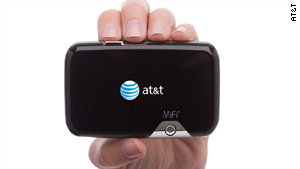
AT&T unveiled its first MiFi gadget on Wednesday, joining Verizon Wireless and Sprint.


AT&T unveiled its first MiFi gadget on Wednesday, joining Verizon Wireless and Sprint.


Two prevailing theories for how we will access the internet in the future hinge on the success of small plastic gadgets called MiFis.

The devices, many of them smaller than a smartphone, are similar to the wireless routers in many homes except they don't need to be plugged into anything.

They connect to a cellular carrier's data network. Once the battery is charged, a MiFi can be taken anywhere, and it provides a Wi-Fi signal to computers or iPods in a nearby vicinity.

In one of those future scenarios, each family would have their own one of these gadgets.

This can be more economical than subscribing to separate data plans for each cell phone and tablet you buy. Some families have found this especially effective for staying connected on road trips or in hotels that don't offer free Wi-Fi.

AT&T introduced its first MiFi device on Wednesday. Sprint Nextel, which already has the 4G-enabled Overdrive, started selling a thinner gadget called the ZTE Peel last week. Verizon Wireless offers the popular MiFi 2200 Intelligent Mobile Hotspot and another equipped for international travel.

These products generally cost $50 to $150 (some require a two-year contract) and $35 to $60 per month for the service, depending on the carrier and amount of data you use. Virgin Mobile also has an unlimited plan for $40 with no contract.

T-Mobile USA, the only of the major wireless carriers not to offer a MiFi device, is considering releasing one next year when it expands and updates its network, Neville Ray, the company's chief technology officer, told CNN recently. Current third-generation technology hasn't been fast enough to serve this growing breed of products, he said.

But telecoms are rapidly improving the speeds of their networks with fourth-generation technology. So MiFi could eventually replace wired broadband subscriptions in the same way that Americans are canceling home phone lines in favor of cell phones. (That depends on whether the U.S. government solves an industry threat relating towireless spectrum availability.)

Telecoms have been hot and cold about which connectivity methods to promote. Should they focus on MiFi as a gadget to connect everything, or on having a 3G chip in each device? Or maybe even on high-end smartphones that have the MiFi functionality built in (an additional fee is required)?

Not long after Apple's iPad debuted in April, Sprint shrewdly began promoting the Overdrive with a case designed to fit the tablet and the MiFi. After selling out of initial stock, the telecom didn't renew the program.

"It achieved its purpose at the time, which was to raise awareness that you can put these two devices together," said Teresa Kellett, Sprint's director of 4G.

When Verizon announced that it would begin carrying the iPad, it bundled the Wi-Fi version of the tablet with a MiFi, rather than selling an iPad with a 3G chip built in, like AT&T does.

Jon von Tetzchner, the co-founder of the Opera browser, endorses the MiFi concept. Not only is it cheaper, but it can be more efficient having one gizmo talk to cell towers and satellites and then distribute that signal to Wi-Fi-enabled appliances in the house, he said.

"In the next 10 years, every device will have an internet connection," Tetzchner said recently.

On the other side of the debate, MiFis are believed by many to be a passing fad. Once every device can have a cellular chip in it, why would we need an extra gadget to carry around?

Telecoms are pushing this concept of "machine-to-machine," which means adding cell chips to refrigerators, stoves and other appliances that you wouldn't normally expect to connect to the Web. Some say this is the future of internet connectivity.

Dan Deeney, co-founder of technology investment firm New Venture Partners, doesn't see a long-term future for the MiFi.

"I think there will be a role for them going forward, but I don't think it'll go mainstream," said Deeney, who works closely with Verizon. "Right now it's a matter of costs. Wi-Fi chips are cheap."

Once the price of cell chips comes down, he says connected machines will become more ubiquitous. In that scenario, each gadget will manage its own connection and won't need to rely on the limited battery life of one MiFi device.

Whichever the outcome, technologists agree that we'll be seeing internet functionality embedded in a lot more products than we have now.

Source: cnn

Thursday, November 18, 2010

Hate the Black Friday lines? Score deals online

black_friday_lines.gi.top.jpg 


By Jessica Dickler, staff writer


It has become as traditional as turkey, stuffing and pumpkin pie: On the day after Thanksgiving, shoppers bundling up and heading out before dawn for retailer's eagerly awaited Black Friday doorbuster deals.
And after two years of dismal holiday sales, retailers are upping the ante to bring shoppers into the stores this season. This year the National Retail Federation estimates that holiday sales will increase 2.3% to $447.1 billion, much improved from last year's 0.4% uptick and the dismal 3.9% sales decline in 2008.

But for those who don't want to face the stores, don't despair. Many of the doorbuster deals will be available online, too.
"This Black Friday, I would like to stay in the comfort of my bedroom possibly online bargain shopping for maybe a table and some things to decorate my new apartment," said Kaitlynn Blyth, who waited outside last year from 7 p.m. until midnight to get Zhu Zhu pet accessories for her younger sister.

Here's where to score the deals:

Best Buy: The same products promoted in its Thanksgiving Ads -- including doorbusters -- will be available on BestBuy.com starting Thanksgiving Day. Best Buy is also offering free shipping on online orders through Dec. 21, excluding laptops, iPads, iPods and some major appliances.

Macy's: Doorbusters, like a KitchenAid Mixer for $179.99, will also be sold both online and in stores on Black Friday.

Amazon: Here's another reason to avoid the Black Friday stampede: The online retailer is matching other retailer's doorbuster prices. Plus, it's offering free shipping.

Toys R Us: The popular toy store will preview more than 60 "Mystery Deals" on its site starting Tuesday, Nov. 23 at 12:01 a.m. But those savings will only be available in Toys R Us stores from 10 p.m. on Thanksgiving Day until 1 p.m. on Black Friday. The toy retailer will also give out free Crayola 64-Packs and coloring books with any purchase, while supplies last.

Wal-Mart: The country's largest retailer is offering online-only specials on Thanksgiving Day in addition to free online shipping with no minimum purchase. However, the doorbuster deals that shoppers camp out for, like a Nintendo Wii for $199 plus a $50 gift card, will be in-store only starting at 12 a.m. on Nov. 26.

Target: Online-only deals start on Thanksgiving Day before the company's popular two-day sale. But the discounter's doorbuster deals are only available at in stores starting at 4 a.m. on Black Friday. In order to get free shipping on the online orders, consumers must spend $50 or more.
The same is true for Sears and Kmart, where there will be online discounts of 30-40% off on Thanksgiving Day, but the deeper discounts of 50-60% will only be in stores on Black Friday. Web shoppers can then pick up their purchases in stores to save on the shipping.

Source: cnn

Google CEO: Android update "could replace credit cards"

By Julianne Pepitone

SAN FRANCISCO (CNNMoney.com) -- The next generation of Android is coming in a few weeks, and that update to the mobile operating system "could replace credit cards," according to Google chief executive Eric Schmidt. At the Web 2.0 Summit in San Francisco, Schmidt said Android 2.3 (code-named Gingerbread) will combine location services with "tap-and-pay" functionality.

"Imagine that instead of typing my search, my phone is sending me information all the time," Schmidt said. "Maybe I tell [my phone] I need a pair of pants, and I get relevant information as I walk down the street."
Android, an open-source operating system widely used in smartphones, will soon use so-called "near-field communications" sensors to read RFID tags and link up with other phones and payment systems. That move will put Google squarely in the center of the growing field of developers working on mobile payments.

Schmidt showed off an "unannounced device" running on Android. The phone, which was black with rounded edges, looked like the rumored Nexus S.

Source: cnn

Friday, November 12, 2010

Mozilla launches F1, a new way to share links

By Jolie O'Dell

While we've seen similar sharing frames and toolbars in the past, this offering from Mozilla is particularly well designed.

Today, Mozilla's Messaging group launched F1, a Firefox extension that aims to make sharing content around the social web much easier. For webmasters and web surfers alike, seeing a row of a half-dozen "share this" buttons above or below every piece of web content can be both visually distracting and existentially confusing.

Many companies are building work-arounds for this common interaction design problem of the digital age, and Mozilla has just thrown its hat into that particular ring. F1 gives users an all-in-one frame above the content they're viewing. Once your accounts are connected, you simply click the tiny F1 icon in the toolbar to share the page you're viewing with friends on Facebook, Twitter and Gmail.
(Those three services were chosen as the first three supported sharing mechanisms for F1 because of their popularity and OAuth implementation.)

In an ideal world, if every web user was a Firefox F1 user, publishers wouldn't have to provide the usual slew of sharing buttons, and users wouldn't have to connect their social accounts and login credentials to scores of websites around the Internet. Sharing would be more secure, simpler and (let's face it) a lot easier on the eyes than it is now. As a Mozilla Labs project, F1 is still being expanded.

As Mozilla designer Bryan Clark wrote today on the company blog, "[Eventually], the system should know which sharing service you use, and offer to use those! That will require sharing services to advertise to the browser that they offer a sharing API and the browser to see which services you use.
"Furthermore, sharing is not a standardized activity, so some protocol is likely needed for user agents to offer users the service they want without having to know about all of them." He also emphasized that publishers can also experiment with this feature; interested parties should check out the F1 wiki for details.

While we've seen similar cross-browser, all-in-one sharing frames and toolbars in the past, this offering from Mozilla is particularly well designed. In fact, we wish there was a cross-browser standard for social sharing; all these buttons have got to go at some point.

What's your take on F1 so far? Let us know your opinions in the comments.

Source: cnn

Thursday, November 11, 2010

How to pick the right HDTV

Quick advice on TV size, panel technology and the cost of cutting corners 

Image: Televisions for sale

Whether the day after Thanksgiving is called "Black Friday" because of the day's heavy traffic or because it signals the beginning of the selling period when most retailers go from being in "the red" to being "in the black," it unofficially marks the start of the holiday gift giving buying season.
Market research company iSuppli predicts that 11.897 million flat panel plasma and LCD HDTVs will sell during the fourth quarter, up slightly over 6 percent from the same period in 2009. Broken out by type, iSuppli forecasts plasma sales should increase over 9.3 percent for Q4 compared to last year while all LCD will be up by 5.61 percent. Clearly, HDTVs are among the most prized gifts. So whether you're giving one to a loved one, your family or yourself, it's important to pick the right one. Here's our advice.

Size Matters 

Job one is to pick the right screen size for your needs. HD LCDs range from 19 inches to 65 inches and plasmas from 42 inches to 65 inches. LCD screens 37 inches and smaller generally feature 720p resolution, though there are a few sets as small as 32 inches offering 1080p.
There are 42 inches and 50 inches 720p plasma sets as well, with all plasma sizes available in 1080p. Rear Projection TVs are not flat, with a depth of around 15 inches. They are offered in screen sizes from 60 inches to 82 inches and provide the biggest image for the least amount of money, with street prices starting at under $1000. All use a single replaceable lamp light source (except one model using lasers). All rear projectors are made by Mitsubishi.
Which size is right for you? Consider your budget, room size, seating positions and finally if it's an issue for you, the size of the cabinet in which you're placing the set. Our exclusive HD Guru viewing distance chart (which can be downloaded in PDF format here) tells you how close you need to sit to see full resolution with a given 720p or 1080p display. Sit farther away and of course you will still get a great picture, but human vision limitations will prevent you from seeing the set's full resolution.


A handy flow chart to help you cut through the jargon and the flood of features in today's HDTVs.

LCD or Plasma?

 LCD is your only choice if size or budget constraints limit you to size below 42 inches. While you have a choice of plasma or LCD at 42 inches and above, HD Guru and most other experts agree that plasma beats LCD (including those labeled "LED") in overall picture quality.
Why? Plasma offers uniform picture quality as you move off-axis, meaning everyone in the room essentially sees the same picture. LCD does not. Off axis, all LCD displays exhibit changes in color, black level and brightness, though some models, offer better off-axis performance than others.
Plasma offers overall better black levels, with blacks always appearing deeper especially when viewed off-axis compared to LCDs, because plasma has the ability to shut light off at a pixel level. Because LCD is a back-lit technology, the best it can do — and not all LCDs have it — is dim large blocks of pixels using a feature called "local dimming." It's not nearly as precise or effective as actually turning off individual pixels and adjacent high contrast images often produce a halo artifact.

CCFL or LED back-lit LCD TV? 

 A relatively recent advance in LCD technology uses LEDs (light emitting diodes) to illuminate the picture in place of the more commonly used thin fluorescent tubes called CCFLs. Though some set manufacturers choose to call their LED back-lit sets "LED TVs" they are still LCD TVs!  However, LED backlighting has a number of advantages, one of which is lower power consumption compared to both traditional back-lit LCDs and plasma. For a given screen size, plasma consumes somewhat more power than CCFL back-lit LCDs. Price wise, large screen plasma (50 inches and over) are significantly less expensive than traditional CCFL LCD and LED LCD. The cost differential is higher than the savings in electricity one can expect, even after 10 or more years of use.
The CCFL lamps within LCDs contain mercury, a toxic metal, while LED LCDs and plasmas are mercury free, something to keep in mind when disposing of an old LCD TV. (Check out our recycling article here for more information.)
Another LED advantage is the capability of very bright images, which makes them preferable to both CCFL back-lit LCDs and plasma if you do a lot of daytime viewing, in very bright windowed rooms that lack shades or curtains. For typical room lighting conditions plasma HDTVs produce sufficient image brightness for outstanding picture quality.

Edge-lit versus back-lit LED

Manufacturers use LEDs to either edge light or back light their LCD sets. Edge lighting can produce thin profile sets that are less than an inch deep. Back lit sets offer the aforementioned advantage of local dimming, which can produce extremely dark black levels.
Edge lit LEDs may have white and black uniformity issues at the picture perimeter while off-axis brightness of both LED formats tends to fall off somewhat more rapidly than does the same panel lit using traditional CCFLs. However, overall, LED back-lit sets with local dimming produce the best LCD pictures.

60Hz/120Hz/240Hz 

 Standard LCDs incorporate a 60 Hz refresh rate. This produces motion resolution of around 320 lines (per picture height) out of a possible 1080 lines. 120 Hz refresh ups the motion resolution to around 600 lines, while 240 Hz kicks it up to 900 lines or higher.
Once the refresh rate is increased to 120Hz or higher, a number of image artifacts appear (see related story). In addition, test material reveals unwanted artifacts present in all types of 120, 240 Hz LCD HDTV.
For the best LCD picture, either traditional or LED back-lit, choose one with either a 120Hz or 240Hz or 480 Hz refresh rate. Note the are LED LCDs that claim 480Hz refresh, really just use a 240 Hz circuit and sequentially fire the LEDs within the backlight.
1080p plasma sets produce artifact free, full 1080 line motion resolution. Panasonic's VT20/ VT25 series and Samsung's 8000 model plasmas offer a 96Hz refresh rate that produces images free of the judder (seen as uneven pans) found in all 60 Hz panels (plasma and LCD) without any of the artifacts associated with 120/240Hz LED/LCDs.

THX 

 If you're looking accurate image reproduction, consider THX Certified designs that provide near ideal out of the box color temperature and color point accuracy when set to the THX picture option. THX is available on select LG and Panasonic HDTVs. User calibration controls, included with many top of the line HDTVs allow (with proper test equipment and signals) near perfection image fine tuning. (Learn more about THX Certification here.)

3-D 

 New for 2010 is 3-D capability. It is available on select LCD models from Samsung, LED LCDs from Samsung, Sony, LG, Sharp and Toshiba and plasma HDTVs from LG, Samsung and Panasonic. Screen sizes range from 40 inches  to 65 inches for LED LCD, 40 inches to 55 inches for LCD with CCFL backlights and 42 inches to 65 inches for plasma. All Mitsubishi rear projectors do 3-D with the aid of a $99 interface box.

Buying your HDTV 

 This year's holiday supply of HDTVs is excellent, due to slower-than-anticipated sales with prices around 25 percent lower than last year. To boost sales, set makers are kicking in with extra savings on a variety of models in the form price reductions, instant rebates, dealer incentives, or bonus offers including free Blu-ray players with TV purchase and multiple free 3-D glasses with 3-D capable TVs.
You can find the great only pricing from Pricegrabber and Amazon using our links within their respective ads on the right side column. For tips on buying a set at a brick and mortar store, check out our feature "Getting the Best HDTV Price."

source: msnbc

Monday, November 8, 2010

Google Sponsors Free In-Flight Wi-Fi for the Holidays


By Adam Ostrow
 
This holiday season, there’s no longer the need to debate whether to pay $9.95 for Wi-Fi on your flight home; Google is stepping up to offer free inflight Wi-Fi from Gogo on Virgin America, AirTran and Delta on all domestic U.S. flights from November 20 through January 2, 2011.
The offer follows last year’s holiday gift to travelers from Google – free Wi-Fi at dozens of airports across the country. With more and more airlines starting to offer inflight Wi-Fi, it seems the timing was right to take the promotion to the skies.
This year’s program is sponsored specifically by the Google Chrome team. On the official Google blog, VP of Product Management Sundar Pichai explains the move, writing, “On the Chrome team, we’re big fans of innovations that make our lives on the web and in the browser better—and it all starts with more ubiquitous access to the Internet.”
Meanwhile, we wonder if free inflight Wi-Fi might tip the scales for you in determining which airline to fly home for the holidays. Let us know if you plan to take advantage of the promotion in the comments.

Source: mashable

Sunday, November 7, 2010

10 home gadgets that take tech too far

- By Sean Fallon


With all of the advancements in technology, it's tempting for designers to go back to the drawing board and "upgrade" some tried-and-true home products. The result is a lot of unnecessary or unusual functionality. As you will see with the following gadgets, sometimes it's best to keep things simple. 


  • Tocky alarm clock


  • Courtesy of Nerd Approved
    The incessant buzzing of a traditional alarm clock is bad enough, but there's no excuse for owning Tocky — an alarm clock that buzzes and rolls away from you. The only way to shut Tocky up is to capture it in a fuzzy, sleepy haze — and there is a good chance that you will sustain some sort of massive shin trauma in the process. Of course, the pain is probably a good thing because simply owning Tocky is a clear sign that you are a masochist. $69 - Nanda Home via Nerd Approved
  • Wicked Lasers Torch
    Courtesy of Nerd Approved
    Every home needs a flashlight for emergencies, but in the case of the Wicked Lasers Torch, the flashlight was probably the causeof the emergency. That's because the Torch shines at a ridiculous 4100 lumens, making it hot enough to scramble eggs, light matches and set paper on fire. Plus, the battery only lasts 5 minutes — not very practical, but more than enough time to do serious damage. The power may be out, but thanks to you the whole neighborhood can see just fine by the light of the blazing inferno that used to be your home. $199.95 - Wicked Lasers
  • Fiber-optic wallpaper
    Courtesy of Nerd Approved
    Wallpaper isn't really a hot item for decorating these days, so if you ever plan on selling your home, I suggest steering clear of 'Nature Ray Charles' wallpaper featuring patterns of embedded fiber-optic lights. Let's just say that the Vegas-after-dark look might clash with the tastes of a prospective buyer. That is, unless the prospective buyer in question happens to be wearing a sequined jumpsuit. $242 per roll - Camilla Diedrich Walls
  • iCarta iPod toilet paper holder
    Courtesy of Nerd Approved
    Toilet paper holders do one job and they do it well, so why mess with perfection by adding an iPod dockand speaker? Unfortunately, that's exactly what you get with the iCarta. Seems like overkill if you ask me, but how long will it be before there's an app that replaces toilet paper? Once there's an app for that, you'll know Apple has really crossed the Rubicon. $65.99 - Amazon
  • Burglar Blaster
    Courtesy of Nerd Approved
    Think about how many times you have accidentally set off your home alarm system. Now imagine if tripping your alarm resulted in a fiery blast of pepper spray. With the Burglar Blaster, you've only got 40 seconds to shut off the infrared alarm or anyone within a 2000-foot radius will be incapacitated with burning eyes and nausea. For the masochist who isn't satisfied waking up with Tocky, this would be the ultimate way to start your morning. $600 - Burglar Blaster
  • Moonlight cushion
    Courtesy of Nerd Approved
    If you thought that the pillow couldn't be gadgetized, think again. The Moonlight Cushion is an illuminated pillow with an internal LED light source that transitions between colors. So those naps on the couch after a heavy, greasy meal might result in crazy tripped out nightmares involving Freddy Krueger hunting you down in the Beatles' Yellow Submarine. $39.98 - Gadgets and Gear via Nerd Approved
  • Nomos touchscreen faucet
    Courtesy of Nerd Approved
    The Nomos faucet features a touchscreen that can help the user adjust water flow, temperature and pressure. It even alerts the user to a malfunction. Those are all great features, but a faucet seems like an awkward pairing for touchscreen technology. I mean, society is paranoid enough about germs and greasy touchscreens already, so you would think that a more hands-free approach is what's called for when you've been handling eggs, raw meat or working out in the yard on something, especially when your wife tells you not to wash your filthy hands in the kitchen, but you do anyway. Price not available - Firma Carlo Frattini
  • Toto Intelligence Toilet II
    Courtesy of Nerd Approved
    Japanese toilet manufacturer Toto is world-renowned for developing toilets with over-the-top functionality. Their latest product in this category, the Intelligence Toilet II, makes going to the bathroom like getting a physical. It's can check your blood pressure, BMI and body weight, analyze urine for sugar levels and even help women keep track of their menstruation cycles by measuring urine temperature and hormone levels. When analysis is done, the data is sent wirelessly to a PC where it is stored and graphed for reference. That's right, when you finally have that child you've been longing for, you'll have the toilet to thank — which could make for an even more awkward parenting moment when your kids ask, "Where did I come from?" $3000-$6000 - Toto
  • ChiliBed
    Courtesy of Nerd Approved
    As a basic concept, the ChiliBed temperature-controlled mattress is actually a great idea. You'll always be toasty in the winter and in the summer you'll have no trouble finding the cool side of the pillow. Plus, two occupants can control their side of the bed independently. The problem lies with the extreme temperature range of the water-based heating elements. The bed can be cooled to 46 degrees Fahrenheit and heated to 118 degrees Fahrenheit. So my wife (who's perpetually cold) can be cremated in her sleep while I (perpetually hot) am cryogenically frozen so that my body can be reanimated during a time with even more advanced bed technology. $1499 to $3499 - Chili Technology via Nerd Approved
  • Fridge Upgrade magnet
    Courtesy of Nerd Approved
    This list contains plenty of real, over-the-top household technology, but the Fridge Upgrade magnet is something that I can only wish was real. The magnet is just for show as it doesn't really allow your fridge to dispense beer, cappuccino, frozen yogurt, french fries, gravy, nacho cheese and chicken wings — but it would be awesome if it could. Mmmm ... imagine making a smoothie with all those ingredients! That would make this toaster/defibrillator concept a lot more practical. $7.95 - Archie McPhee via That's Nerdalicious!

    Source: msnbc