Friday, October 29, 2010

Four Vans Successfully Navigated From Italy to China Without Drivers or Maps

Four Vans Successfully Navigated From Italy to China Without Drivers or Maps 


Without satellite navigation to guide them, or even humans behind the wheel, four vans made the 8,000 mile journey from Italy to China. Seven video cameras combined with solar powered laser scanners made the trek, which ended today, possible.

The vans did house researchers, just in case an emergency—like crazy traffic, which happened in Moscow, or toll booths—occurred. One of the vans decided to stop and give a hitch hiker a lift at one point.
The trip was performed as part of a road safety experiment aimed at improving automotive technology. It uses an automated vision system called GOLD, Generic Obstacle and Lane Detector, to adjust the
 speed and direction of the vehicles. The researchers hope this system could be used in cars to enhance and complement drivers' abilities.

Source: gizmodo

Aw Man, Even Mount Everest Has Better 3G Reception Than We Do

Aw Man, Even Mount Everest Has Better 3G Reception Than We Do

Climbers of Mount Everest spent the past 24 hours updating Facebook statuses, after Nepal's first-ever 3G connection was switched on yesterday at the base camp. The first use of the service? Making the world's highest video call.

Source: gizmodo

Thursday, October 28, 2010

Jobless claims drop for 4th time in 5 weeks

Hopeful sign that job market may be improving

Fewer people applied for unemployment benefits last week, the second drop in a row and a hopeful sign the job market could be improving.
The Labor Department says initial claims for jobless benefits dropped by 21,000 to a seasonally adjusted 434,000 in the week that ended Oct. 23.
It was the second-lowest number for claims this year. The only time it was lower was during the July 10 week, and that week was affected by the Independence Day holiday when state unemployment offices were closed.
Claims will need to keep falling to signal a widespread increase in hiring. Claims have fluctuated around 450,000 for most of this year, and have fallen below that level seven times. But they have always rebounded in subsequent weeks, and haven't remained below 450,000 for longer than two weeks.
Story: For some, jobless benefits trump a job The four-week average, a less volatile measure, dropped by 5,500 to 453,250, the lowest level since the week of July 24.
"A couple of months ago we started seeing improvement in numerous gauges of employment, and we're slowly getting that confirmation from data that's been coming out. You tend to use moving averages on this, not just one week, but it was better than expected," said Steve Goldman, market strategist at Weeden & Co.
Applications for unemployment aid fell steadily last year after the recession ended in June 2009, dropping from 600,000 to about 450,000 by January of this year.

Employers haven't done much hiring in recent months with economic growth so weak. The economy grew 1.7 percent in the April-June period, an anemic pace in normal times and even worse in the aftermath of the Great Recession.
Economists expect that the Commerce Department on Friday will report slightly better growth of 2 percent for the July-September period. But that's still sluggish after a deep recession.
The economy needs to grow by at least 5 percent for a full year to bring down the unemployment rate by a percentage point, economists estimate. The jobless rate is currently 9.6 percent, down only slightly from 9.7 percent in January.
Some companies are adding workers. Pharmaceuticals company Novartis AG said Wednesday that it will add 300 new jobs and invest $600 million over the next five years in its research headquarters in Cambridge, Mass. And engine maker Cummins, Inc. said Tuesday that it will expand its headquarters in Columbus, Ind. and add at least 350 jobs by 2012.
The number of people continuing to receive jobless aid also dropped sharply last week, falling by 122,000 to 4.36 million, the department said. But that doesn't include an additional group that is receiving extended benefits under an emergency program approved by Congress during the recession.
The emergency benefit rolls fell by more than 400,000 to about 4.7 million for the week ending Oct. 9, the latest data available. Much of the decline is likely due to people using up all the unemployment aid they are eligible for.
All told, about 8.8 million people received unemployment benefits that week.

 Source: msnbc

World's fastest supercomputer belongs to China

The supercomputer was unveiled yesterday at the Annual Meeting of National High Performance Computing.

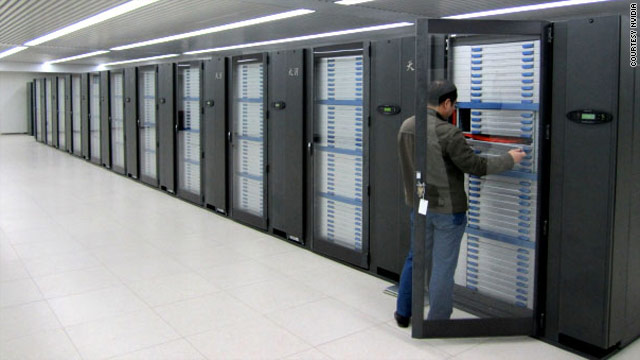
Unveiled Wednesday at the Annual Meeting of National High Performance Computing (HPC China 2010) in Beijing, Tianhe-1A is the world's fastest supercomputer with a performance record of 2.507 petaflops, as measured by the LINPACK benchmark.
Tianhe-1A was designed by the National University of Defense Technology (NUDT) in China, and it is already fully operational.
To achieve the new performance record, Tianhe-1A uses 7,168 Nvidia Tesla M2050 GPUs and 14,336 Intel Xeon CPUs.
It cost $88 million; its 103 cabinets weigh 155 tons, and the entire system consumes 4.04 megawatts of electricity.
Tianhe-1A ousted the previous record holder, Cray XT5 Jaguar, which is used by the U.S. National Center for Computational Sciences at Oak Ridge National Laboratories.
It is powered by 224,162 Opteron CPUs and achieves a performance record of 1.75 petaflops.
According to Nvidia, Tianhe-1A will be operated as an open access system to use for large scale scientific computations.

Source: cnn

Wednesday, October 27, 2010

Billionaires wanted for starship plan

For some billionaires, space travel is a cause worth big bucks. The examples range from Virgin Group chairman Richard Branson, who's putting together what's likely to be the first suborbital spaceline, to Amazon.com founder Jeff Bezos, who is backing the publicity-shy Blue Origin space venture (and benefiting from NASA funding).
But how far are deep-pocketed space fans willing to go? Pete Worden, the director of NASA's Ames Research Center, recently hinted that billionaires are being recruited to kick in contributions for a deep-space mission known as "the Hundred Year Starship." The idea builds on the long-discussed concept of sending people on one-way missions to space destinations, in hopes of jump-starting colonization of the final frontier.
Worden is quoted as saying NASA has already committed $100,000 to the project, with the Pentagon's Defense Advanced Research Projects Agency providing another $1 million in funding. His comments, made at the Long Now Foundation's "Long Conversation" event on Oct. 16 in San Francisco, were reported by KurzweilAI's Amara D. Angelica.

Worden said NASA and DARPA have "just started" the project. "We also hope to inveigle some billionaires to form a Hundred Year Starship fund," he was quoted as saying.
"The human space program is now really aimed at settling other worlds," he said. "Twenty years ago, you had to whisper that in dark bars and get fired."
Actually, quite a few people have been talking about the idea, although deep-space colonization has not previously been mentioned as part of NASA's official space vision. Two researchers discussed the options for one-way trips to Mars this month in the Journal of Cosmology, and at this month's International Astronautical Congress in Prague, experts reviewed the possibilities for interstellar trips.
Worden said he has discussed the potential price tag for one-way trips to Mars with Google co-founder Larry Page, telling him such a mission could be done for $10 billion. "His response was, 'Can you get it down to $1 [billion] or $2 billion?' So now we're starting to get a little argument over the price," Angelica quoted Worden as saying.
When it comes to sending colonists to other planetary systems, Page and his fellow billionaires shouldn't expect a quick return on their investment. "If we expect to be sending hundreds of people out to colonize another planet, we're really talking about something that's going to take 100 years or more to really make happen effectively," Derrick Pitts, chief astronomer at the Franklin Institute in Philadelphia, said on MSNBC today.

Source: msnbc

Tuesday, October 26, 2010

Google admits to accidentally collecting e-mails, URLs, passwords

By Marina Landis

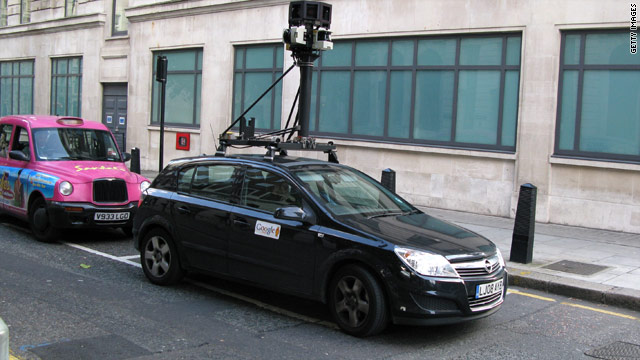
Google's use of Street View cars led to a flurry of privacy probes after the company unintentionally captured unecrypted data.

Google admitted in a blog post Friday that external regulators have discovered that e-mails, URLs and passwords were collected and stored in a technical mishap, while the vehicles for Google's Street View service were out documenting roadway locations.
According to Google, data was mistakenly collected in more than 30 countries, including the United States, Canada, Mexico, some of Europe, and parts of Asia.
In the blog, posted by Alan Eustace, senior vice president of engineering and research, he noted "we failed badly here" and added that Google has spent months analyzing how to strengthen their internal privacy and security practices.
"We want to delete this data as soon as possible, and I would like to apologize again for the fact that we collected it in the first place," Eustace wrote.
Google announced in May that it had collected unencrypted WiFi data by mistake through its Street View service, but the severity of the situation was unknown.
According to a Google spokesperson, the company first became aware of the problem when the Data Protection Authority in Germany asked Google to review all of the data collected through its Street View cars as part of a routine check. The spokesperson added that in addition to street locations, Street View cars also collect WiFi data about hot spots in order to improve the location database for things such as Google Maps for mobile.
When Google went back and looked at the data, it turned out that in addition to WiFi hot spots, they were mistakenly collecting information that was being sent across unencrypted networks.

For the information to have been collected by Google, a person had to have been sending something over an unencrypted network at the same time that a Street View car was collecting data in that same location.
According to Google, the vast majority of the data is in fragments, but in the past week several countries have issued reports that they have found entire emails and passwords.
The data has since been segregated and secured, and WiFi data is no longer being collected from Street View cars.
Google has deleted the data collected from Ireland, Austria, Denmark and Hong Kong, but other countries have opened their own investigations, and Google has not been given permission from authorities to delete the data.
In a statement, Connecticut Attorney General Richard Blumenthal said, "This alarming admission that Google collected entire e-mails and passwords validates and heightens our significant concerns. Our multistate investigation, led by Connecticut, into Google's alleged invasion of privacy through wireless networks is continuing."
In the blog post, Eustace outlined the steps that Google is taking to strengthen its internal privacy and security practices including appointing a director of privacy across both engineering and product management and enhancing the core training that engineers and employees responsible for data collection receive.
"We are mortified by what happened, but confident that these changes to our processes and structure will significantly improve our internal privacy and security practices for the benefit of all our users," Eustace wrote.

Source: cnn.com
 

Friday, October 22, 2010

HP Slate: The $800 business netbook without a keyboard

The Slate was proudly touted by Microsoft's Steve Ballmer as an iPad killer, back before the iPad even existed.


By Charlie Sorrel, WIRED
  • HP reveals 8.9-inch tablet with capacitive multi-touch and that runs Windows 7
  • HP Slate 500 Tablet PC is just that, a PC
  • Slate is also Wi-Fi only: There's no 3G radio

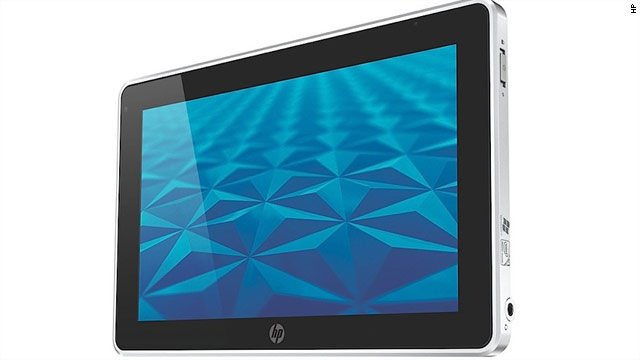
(WIRED) -- HP has at last revealed its long-awaited Slate, an 8.9-inch tablet with capacitive multi-touch and running Windows 7. The Slate, you will remember, was proudly touted by Microsoft's Steve Ballmer as an iPad killer, back before the iPad even existed.

So is this an iPad competitor? No freakin' way.

The HP Slate 500 Tablet PC is just that, a PC. It runs on a 1.86GHz Intel Atom Z540 processor, has 2GB RAM and a 64GB SSD, along with a Broadcom accelerator for 1080p video, a USB port, HDMI-out, a hardware Ctrl-Alt-Delete switch, a button to activate the on-screen keyboard and a pair of cameras, one on the back for photos and one on the front for Skyping.
It also has, somewhat unbelievably, a slide-out Windows license.
That's right. Apparently any machine with Windows pre-installed needs to show the license info and HP, in order to keep the rear design clean, opted to add a slide-out plastic bar to display it.
Oh, it is also Wi-Fi only: There's no 3G radio.
There is one nice touch: the screen includes a Wacom digitizer so you can use a stylus to take notes on screen. There is nowhere to store the stylus, though, so you'll lose it soon enough.
Clearly, the Slate is to full-featured tablet PCs as a netbook is to a proper notebook: a scaled back, underpowered portable with a too-small screen, running an OS designed for the desktop, not a touch-operated device.
HP has tried to justify the ridiculous price with a disclaimer in its press release, which says it is "designed specifically for business." The problem is, businesses are already buying the iPad, which is designed just to be good.
We're certainly looking forward to seeing some proper rivals to the iPad, with ten-inch screens running an OS designed for touch. The HP Slate, a netbook with the keyboard missing, ain't it.

Source: cnn

Thursday, October 21, 2010

Do FaceTime on your Mac today


Today, Steve Jobs announced that now you can do FaceTime -- that cool video conferencing program where you can see yourself and the person you're talking to on the same screen -- on your Mac with a beta release, FaceTime for Mac, today.

This will allow Mac desktop and MacBook users to communicate via FaceTime with other users on 19 million iPhone 4s and iPod touches.

Source: msnbc

Apple's new Mac OS X Lion


At an event in California today, Apple head honcho Steve Jobs showed off a new version of Mac OS X. As many predicted, the operating system will go by the name OS X Lion, but Jobs also announced that it will include a new Mac App Store.
Jobs said that the idea behind Mac OS X Lion is to bring what they learned from taking OS X to the iPhone and iPad with the iOS operating system back to the Mac OS itself. Hence the "Back to the Mac" title of today's event.
"Lion brings many of the best ideas from iPad back to the Mac, plus some fresh new ones," Jobs said. In fact, he described Lion as "Mac OS X meets the iPad."
Mac OS X Lion will be released in the summer of 2011.
Perhaps the most interesting new addition announced alongside the Lion news, is the forthcoming Mac App Store.
"The App Store has completely revolutionized how people get their apps on their iPhone and the iPad and why not th Mac too?" Jobs said.
As with the iPad, users will be able to purchase apps using their iTunes account, then download and install those apps in one step. App updates will be delivered through the Mac App Store. But Mac users won't actually have to wait for Lion to launch to get their hands on the  newest App Store. Jobs said the Mac App Store will be available for Snow Leopard (the current OS) within 90 days.
In addition to the Mac App Store, OS X Lion also will include expanded use of multi-touch gestures and system-wide support for iPad-like full screen views of applications.
As far as multi-touch gestures go, Jobs said, "We've done tons of user testing on this and it turns out, touch surfaces don't want to be vertical. It gives great demo but after a short period of time you begin to fatigue and after an extended period of time your arms want to fall off."
Multi-touch trackpads are the best way to get multi-touch into a notebook, Jobs said, and that is how they're going to use it on their Mac products going forward.
At Wednesday's event, Jobs also announced that OS X Lion will include Launchpad, a new home for all Mac apps (similar to the Home screen on an iPad) which is meant to make it easier for users to find and launch their applications. As with the iPhone and iPad, Launchpad will make it so Mac apps can be organized in any order or grouped into folders. And users will be able to swipe through multiple pages of apps to find what they're looking for.
And in an additional effort to ease navigation, Lion also will offer Mission Control, which presents users with a unified view of every app and window running on their Mac, allowing them to instantly navigate to whever they want to go. It incorporates Exposé, Dashboard, Spaces and thumbnails of full-screen apps.
For more "Back to the Mac" news, be sure to check out Wilson Rothman's live coverage of the event.

Source: msnbc

Apple's new MacBook Air: As if a laptop 'hooked up' with an iPad


By Mark Milian, CNN
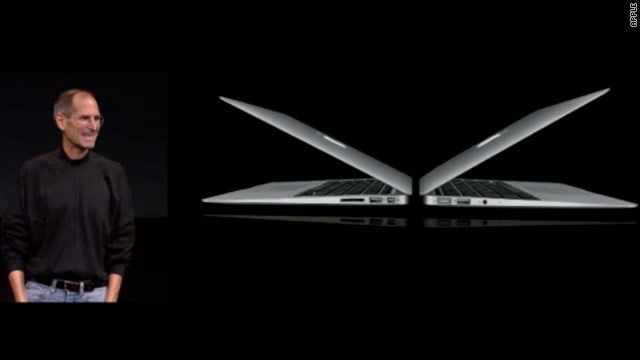
Apple CEO Steve Jobs unveils sleeker, lightweight MacBook Air laptops at an event Wednesday.

While Apple's Wednesday event was called "Back to the Mac," much of the undertones harkened back to its popular touch-screen products. Apple released a redesigned line of laptops and offered a peek at new Mac software at a news conference at its Cupertino, California, headquarters. The MacBook Air laptops will be available to buy Wednesday in 11- and 13-inch-display models. The smaller size costs $999, and the larger costs $1,299. Neither model includes a hard drive or DVD player.

Instead, the MacBook Air uses what's called flash storage, a more efficient but pricier technology used in many of the company's other portable products. That costliness is evident in the base model, which only has 64 gigabytes of space. (It costs an extra $200 to double the storage.) This flash memory helps the new MacBook Air achieve between five and seven hours of battery life when surfing the Web, and 30 days of standby time. That also allows the computer to turn on almost instantly. The machines are lighter, at 2.3 to 2.9 pounds, and thinner -- the wedge-shaped aluminum gizmos measure just over two-thirds of an inch at the widest edge. "We really see these as the next generation of MacBooks," Steve Jobs, the company's chief executive, said at the event. "We think all notebooks will be like these someday."

Rather than using DVDs, software will be installed through a new App Store, similar to the digital marketplace on Apple's iPhone and iPad. This digital store can be downloaded to Macs running the newest version of OS X Snow Leopard sometime in the next 90 days, Jobs said.
For an event centered around Apple's flagship Mac computers, the focus Wednesday often turned to its mobile-focused iOS software.

"We've invented some new things, and we've perfected them over the last several years," Jobs said of iOS. "We're inspired by some of those innovations. We'd like to bring them back to the Mac."
Apple also demonstrated it hasn't run out of jungle-cat names with its new Lion operating system. The software borrows many concepts from iOS, including a similar presentation of software, full-screen use, a focus on touch navigation and, of course, the App Store.
Apps aside, Apple said it would release a Mac version of FaceTime, the video chat program for iPhone and iPod Touch, on its website Wednesday.

A new version of the iLife software, which includes apps such as iPhoto, GarageBand and iMovie, was also released Wednesday, costing $49. It's included with new Apple computers. These apps can aid struggling musicians or let users craft boilerplate movie trailers.
The new MacBook Air, too, borrows things from Apple's hand-held products.
"What would happen if a MacBook and an iPad hooked up?" Jobs joked. "This is the result."
But don't expect to be able to tap buttons on the laptop's screen.
"Touch surfaces don't want to be vertical," Jobs said onstage. "After a short period of time, you start to fatigue. And after an extended period of time, your arm wants to fall off. It doesn't work. It's ergonomically terrible."

Due to the size of these new computers, some observers may be quick to draw comparisons to netbooks. But those devices are usually cheaper and pack a slower type of processor.
"Netbooks are getting squeezed on all sides," including pressure from tablets, said Gartner analyst Van Baker. The netbook market "grew very fast, and now they're shrinking very fast," he added.
"The question now is: Are full-blown notebooks going to replace netbooks?" Baker said.
Apple is spring-boarding from a record quarter for its computer division, having sold 3.89 million Macs between late June and late September. While the company sold more iPhones, iPods and iPads than Macs, profit margins on desktops and laptops are generally higher, so they make up a crucial part of Apple's revenue.

Computers made up a third of Apple's revenue last year, Tim Cook, chief operating officer, said during the news conference.
"If it was a standalone company -- and we have no plans to do that," Cook joked, "it would be 110 in the Fortune 500 list."

Source: cnn.com

Wednesday, October 20, 2010

Starbucks launches in-store digital network with lots of free content

By Wilson Rothman


Four months after making its in-store Wi-Fi free, Starbucks is now using that connection to give away premium content from the Wall Street Journal, Nickelodeon, Apple's iTunes and others. If you are connected to the in-store Wi-Fi, you're on the Starbucks Digital Network and can get this stuff for free.
The network was built in partnership with Yahoo. At launch, here are some of the key "premium" content providers:

WSJ.com - In the store, it's as if you're logged in as a subscriber; subscriptions cost over $100 a year.

New York Times Reader 2.0 - A Web app that reads like a newspaper, and normally requires a subscription.

iTunes - In addition to "Pick of the Week" downloads, there will be featured music and videos available (to keep) for free. (iTunes is also the "click to buy" content provider for books and other stuff available on the Starbucks network.)

Bookish Reading Club - Hachette, HarperCollins, Penguin, Simon & Schuster and others will be sharing full text of new releases, and preview chapters of upcoming books.

Nick Jr. Boost - The service, which outside of Starbucks costs about $80 per year, streams full-length episodes of Dora the Explorer, Ni Hao Kai-Lan and other shows.

Zagat - Since, when you're logged into the store, you're at a known location, subscription-based Zagat can give restaurant recommendations to a dozen highly rated restaurants in the vicinity.
There are also quite a few content providers whose stuff is generally available, but not necessarily in the same formats, including The Weather Channel, USA Today, and the geographically minded social network FourSquare, which lets you "check in" from the Starbucks Digital Network's start page instead of from your cell phone.

Besides entertainment and news, there are some channels that are meant to appeal to key Starbucks demographics. Business & Careers, aimed at jobseekers and consultants who regularly work from coffee shops, includes content from LinkedIn, including a free trial of its premium job-hunting service. The Wellness channel includes content from Rodale, including stories from Men's Health, Women's Health and lesser known publications like Organic Gardening.
Obviously, there are some immediately compelling aspects to this: Browsing the Wall Street Journal is something a lot of people would do if they didn't have to pay for it, and checking out more than just a few pages of a new book makes a lot of sense, even if you don't like standing around in bookstores. And parents who want to run in for a Venti Mocha can give their kids some brain candy while they're at it. (Hey, judge if you want, but parents know that having that option is awesome.)
And Starbucks, ever conscious of the tech trends, has urged that the content be tablet- and smart phone-friendly. Not only does this mean that screens are easy to navigate with your finger, but it also means you probably won't see any messages about needing the Flash player to see a video. Yep, Starbucks Digital Network was built with HTML5 to be touch — that is, iPad and iPhone ... and Steve Jobs — friendly.

Speaking of iPhones, the myStarbucks app will now log you into the network with a tap if you so choose.

There's not a lot of downside here. If you spend a lot of time working and studying in coffee shops where there's free Wi-Fi, the Starbucks option is probably already on your list. If you like a nice break in your work, then these present some decent choices.
Though there is certainly going to be more content coming, and soon, there may never be any high-quality long-form content, like major Hollywood movies. Forget that it takes a lot of bandwidth to deliver, Starbucks may not want you streaming a two-hour movie while you slowly sip a single short latte. Still, you never know, especially given the sudden popularity of premium streaming video from Hulu and Netflix, not to mention the ongoing content partnership with Apple, which just relaunched its own streaming TV strategy.
The good news is, it's free, and rolling out nationwide now, so it's worth a try no matter what.

Source: msnbc

Tuesday, October 19, 2010

Going to Mars ... on a one-way trip

NASA ( In an artist's conception, a Mars explorer surveys one of the Red Planet's grand canyons)


Will the first explorers to visit Mars come back to Earth? Or does it actually make more sense to leave them there? The idea of sending the Red Planet's first settlers on one-way trips has been kicking around for years, and now two researchers have published a paper in the Journal of Cosmology laying out how such missions could play out between now and 2035.
"It is important to realize that this is not a 'suicide mission,'" Washington State University's Dirk Schulze-Makuch and Arizona State University's Paul Davies write. "The astronauts would go to Mars with the intention of staying for the rest of their lives, as trailblazers of a permanent human Mars colony."
In a WSU news release, Davies said the concept follows the model set by past human settlements of new lands. "It would really be little different from the first white settlers of the North American continent, who left Europe with little expectation of return," he said.

Back in the mid-1990s, rocket scientist and Mars Society founder Robert Zubrin pointed out that "colonization is, by definition, a one-way trip," and since then experts have debated the best way to do one-way. Four years ago, X Prize co-founder Peter Diamandis suggested setting up a private-sector "Mars Citizenship Program," with volunteers kicking in from $10,000 to $1 million each, About 100 candidates would be chosen by lottery to take the trip to a Red Planet colony prepared for them by robots. (Scroll down through this Cosmic Log archive for details, plus reader reaction.)
Davies' colleague at ASU, theoretical physicist Lawrence Krauss, caused a stir last year by reviving the idea of one-way trips to Mars. Because much of the anticipated cost of a voyage to Mars was wrapped up in getting the voyagers back home again, eliminating the return trip would make the mission much more affordable. What's more, he suggested that the Mars voyagers might not be fit enough to make the return trip, due to radiation exposure. "As cruel as it may sound, the astronauts would probably best use their remaining time living and working on Mars rather than dying at home," Krauss wrote in his New York Times op-ed.
Schulze-Makuch and Davies don't think life on Mars would be so bad, judging by the scenario they lay out:
  • First, robots would identify a suitable location for a colony, based on the availability of a natural shelter (such as a lava tube cave) and the availability of water (in the form of ice, of course) as well as minerals and nutrients. Robo-construction crews could make the place habitable for humans.
  • The first one-way missions might involved two spaceships, each with a two-person crew. One of the astronauts should be a trained physician, and all of them should have scientific and technical know-how as well as a passion for research and exploration.
  • Those first colonists should be beyond reproductive age, due to the concerns about radiation as well as reduced life expectancy in a frontier environment.
With time, a series of cave-centered biospheres could be built for the growing Martian community, with beefed-up radiation protection. "Probably several decades after the first human mission, the colony's population might have expanded to about 150 individuals, which would constitute a viable gene pool to allow the possibility of a successful long-term reproduction program," the researchers write. "New arrivees and possibly the use of genetic engineering would further enhance genetic variety and contribute to the health and longevity of the colonists."
Schulze-Makuch and Davies say the Mars colony would provide a long-term base for exploring the Red Planet and looking for traces of ancient or extant life. It would serve as an insurance policy for the species, just in case a killer asteroid or a killer virus endangered life on Earth. And it also could "offer a springboard for human/robotic exploration of the outer solar system and the asteroid belt."
The researchers don't delve into the costs or the detailed logistics for one-way missions, but they do note that NASA's space vision calls for just the kinds of heavy-lift rockets and robotic capabilities that would mesh with future voyages to Mars. "We estimate that a reasonable time line for establishing a permanent unmanned base with robots would be 20 years, with the first human contingent arriving shortly thereafter," they write. "The main impediment is the narrow vision and the culture of political caution that now pervades the space programs of most nations."
Would you agree? Or would it be even tougher to find intelligent, healthy volunteers willing to spend the rest of their lives on a frozen, radiation-blasted world? Whenever we've posed this question before, a fair number of people say they'd definitely go. Four years ago, 374 of the 1,169 msnbc.com users who responded to a Live Vote said they'd be willing to "pay a substantial price" for a one-way trip, assuming that the risk was acceptable. This time around, I'd love to hear your reasons for taking the one-way trip. (Or not taking it!) Just leave a comment below.

How to protect your Facebook info


Facebook's 10 most popular applications are among those transmitting users' IDs to outside advertisers, according to a report from The Wall Street Journal. The report also highlights the ongoing problem of the "app gap" -- Facebook users who don't use applications are still at risk of having their personal information shared with third parties if they're Facebook "friends" with people who do.
Best way to prevent Facebook applications from sharing your personal information with behavior-tracking advertisers? Don't play FarmVille or whatever. Don't take that quiz. If you've done it in the past – well, your stuff is probably out there. But it's not too late to lock down your profile from future share-happy apps. You can ditch 'em completely, tweak them individually.
Here's how:
  • Click "Account" on the top right corner of your Facebook profile.
  • From the dropdown menu, click "Privacy Settings."
  • On the bottom left corner of the page, click "Edit your settings."
  • This should bring you to a page titled: "Choose Your Privacy Settings & Applications and Websites."
  • See "Applications you use" – it's the first item on the page.
  • Within "Applications you use," you'll see two choices.
    1. "Remove unwanted or spammy applications" (lets you pick and choose)
    2. Turn off all platform applications (will disconnect you from all applications, as well as outside websites and Web pages you "like.")
  • "Remove unwanted or spammy applications" (lets you pick and choose)
    Clicking the above option will bring you to "Applications, Games, and Websites > Applications you use.
Didn't know you clicked on all that junk, huh?
Now you have the option of both deleting the applications you don't want up in your business.
You can also open each application and edit the settings and decide how much you want to share on each individual program.

"Turn off all platform applications."
  • Click the above option. If you're currently using any games or other applications, you should get one of those "are you sure?" type prompts that says:
If you turn off platform, you'll be disconnected from all applications and websites. That means friends won't be able to use them to interact with you, and information and settings you've saved may be permanently deleted. To disable all applications at once, click "Select all."
This ain't "Sophie's Choice." Kiss your cows goodbye and delete 'em.
Keep your friends from sharing your information
  • Return to "Choose Your Privacy Settings > Applications and Websites"
  • See "Info accessibility through your friends" -- it's the second item on the page.
  • Click "Edit Settings"
  • "Info accessible through your friends" should pop up on the page.
  • Uncheck everything. Click "Save Changes"

Friday, October 15, 2010

The Ultimate Smartphone Camera Battle

The Ultimate Smartphone Camera Battle
Smartphone cameras are becoming increasingly powerful-many, in fact, are fully capable of taking very sharp and professional looking photos. But are these phones capable of holding their own against more sophisticated equipment? And which phone does it best?
To make a fair comparison, we compared smartphone shots taken in a bevy of different lighting scenarios, including controlled and low lighting, and also tested flash capabilities. We didn't have all of these phones at exactly the same time, but we did make a concerted effort to control the lighting as much as possible.
You'll also notice that the size of some of the images appears different. We wanted to show you the native dimensions of the images these cameras take, and their respective dimensions as well.

The Contenders

HTC Droid Incredible: Features Galore

The Ultimate Smartphone Camera Battle
From a features standpoint, the Incredible's camera takes the cake, offering an incredible amount of customizable options including meters that let you adjust brightness, contrast, saturation and sharpness, all in real time.  The Incredible also offers a ton of effects, including Sepia, Solarize, Posterize, and more.
Most impressive, however, is the actual manual control you are allowed if you happen to be photo geeks like us.  If you want it, full control is yours.  This includes control of ISO, white balance, resolution output, and a heap of other awesome features usually only reserved for the latest, full blown point and shoot cameras.  On paper, it's one of only two phones that sports an 8 MP camera-three up from the rest in case you're planning on printing larger-than-normal images.

Samsung Epic 4G: Killer Screen, Killer Flash

The Ultimate Smartphone Camera Battle
The Epic 4G is an impressive phone with an impressive camera. The flash in particular performed admirably, even in low light scenarios.  A common problem for many phone cameras (and point and shoots) when shooting in low light is the censor often has difficulty speaking to the flash, often resulting in washed out images that are far too lit.
The Epic also offers a pretty broad range of camera features and customizable options-you can manually set the ISO, use light metering (a feature often reserved for digital SLR cameras), and adjust white balance and resolution settings, to name a few options.  It also comes pre-loaded with four effects, which is appreciated, but not nearly as many as the HTC Incredible.
Finally, without a doubt, the Epic has the best looking in-camera screen of all of the phones in the test, hands down, bar none.

iPhone 4: Snappy and Simple

The Ultimate Smartphone Camera Battle
I'm probably just preaching to the choir at this point, but I'll say it anyway:  It's really simple to use.  In fact, it's the simplest of all the phones to load up the camera, and also features the snappiest auto focus sensor we tested.
We did, however, run into a few problems with the built in flash that we'll talk about during the comparison, and, like the BlackBerry, there's only a limited amount of customizable options.  The lack of options is partially saved, though, by an HDR mode that actually works pretty well under the proper lighting conditions.

BlackBerry Torch: The Underdog

The Ultimate Smartphone Camera Battle
The BlackBerry's camera capabilities, much like the phone itself, can be pretty impressive but kind of frustrating to use. On the plus side, the Torch comes with a huge range of scene modes, including face detection, Potrait, Landscape, and even more obscure environmental settings like Snow and Beach modes. Speaking of environments, the Torch did a phenomenal job recognizing shifts in the environment when the scene mode was set to Auto-it alerted us when we were in an environment with low light, for example.
Unfortunately, the customization sort of ends there. There's hardly any manual control offered at all. This didn't used to matter, but with the recent upswing in mobile camera technology, manual customization becomes a desirable option.

Droid X: Beastly

The Ultimate Smartphone Camera Battle
Far and away the largest phone in the roundup, the Droid X is the only other phone in this roundup that also includes an actual shutter button, which, when coupled with the massive 4.3 inch display, makes for a very solid feeling camera, and also is easy on the eyes thanks to the massive screen.  The Droid X camera also has a pretty decent amount of features, offering seven effects, eight ‘scenes' (portrait, landscape, sports, etc) and a controllable flash.
Unfortunately, it lacks much of the manual control and abilities of its Droid based competition, the Incredible, but it's still the only other phone in this roundup that matches it at 8 megapixels.

Droid 2: Beastly Jr.

The Ultimate Smartphone Camera Battle
The Droid 2's camera settings are identical, feature for feature, to the Droid X.  We're figuring that's because they were released around the same time and made by the same company, but there is one puzzling difference:  The Droid X features an 8 MP camera, while the Droid 2 features a 5 MP camera.

Test #1: Controlled Light

These cameras have more than enough megapixels to capture some pretty exacting detail, so, if we set up a soft box and wanted to take a dramatically lit portrait, could the phones pull it off? We wanted to find out how these devices would react to a controlled lighting environment.
Such an experiment will test a couple of important factors. Can the censor in these cameras color balance for dramatic light, without blowing the image out? Also, the pictures were taken in relatively low light, so are the shutters in these tiny little lenses fast enough to avoid motion blur?
We're going to use a digital SLR shot as a reference point. The portrait of features editor Amber Bouman below was taken with a Nikon D300, and is as close to the actual lighting configuration we set up in our lab as humanly possible.
The Ultimate Smartphone Camera Battle
This was taken with a 12 MP Nikon D300. Dramatic light could potentially confuse a point and shoot censor, so we were curious as to which phone could re create this dramatic look. Results below.

The Ultimate Smartphone Camera Battle
As we'll be doing with the majority of our tests, we're going to take the best two and compare their image quality. The top two images from this test are pretty clear. Let's scrutinize the two best pictures to find out which one comes out on top. (Hint: it's not the BlackBerry).
Droid Incredible:
The Ultimate Smartphone Camera Battle
The Droid Incredible did a magnicifant job balancing the light in this image, and didn't blow out or misjudge color corrections like the other phones. Though the Epic did a pretty good job handling color corrections, it blew out a part of the background, where the softbox was shining. In fact, look at the far right side of Amber's head. See how natural her hair is lit? Now look at the iPhones image, which totally blew out the highlights in her hair. (Sorry Amber, that didn't come out right.) All in all, the Incredible really did a terrific job balancing all of the proper necesseties needed to make this image look the way it does, producing a surprisingly detailed and professional looking image that we think looks even better than the DSLR snapshot.
iPhone 4:
The Ultimate Smartphone Camera Battle
The iPhone's image is worthy of mentioning just because of the crazy amount of detail it picked up on. See that catch light in her eye? Notice you can actually see the color of her eye? However, the image suffered from a recurring problem we've found with the iPhone 4: a slight purplish-bluish hue. This seemed to happen almost every time direct light was involved (including use of the iPhone's flash), and though the images are surprisingly detailed (it's hard to believe the iPhone's camera is only 5 MP), it can't compete with the color clarity and smoothness of the Droid Incredible.
The Winner: The HTC Droid Incredible - Outstanding Color and Light Balancing.

Test #2: Natural Light

We knew this was going to be hard to gauge, because a nice, bright day looks the same on almost any camera. But it's an important factor—we reckon the majority of everyday phone users would use their camera in naturally lit environments more so than anywhere else.
As stated above, choosing was pretty difficult, as most of our smart phones delivered some great results (though what's with the undersaturated image Droid 2?). In the end, the showdown comes down to the two phones that captured exacting detail and saturation levels.
The Ultimate Smartphone Camera Battle
Let's have a look at the top two from the bunch.
iPhone 4:
The Ultimate Smartphone Camera Battle
Shocked again, we had to give the iPhone some praise here, for reproducing the most eye-catching image of the bunch with some pretty vibrant colors. The image itself is a messy one, but Apple's image censor picked up on the subjects quickly and precisely—the iPhone 4's shutter fired faster then any of the other phones when taking this particular picture. As you can see, it was an extremely bright (and hot) day, and the iPhone did oversaturate the image just a smidge, but not enough for any major concern.
Samsung Epic:
The Ultimate Smartphone Camera Battle
As you can no doubt tell from this picture, the Samsung Epic has a super wide lens, and we really really like it for that reason, but were also very impressed with the amount of detail picked up in this photo, especially the spot on color match on the actual little Droids. Unlike the iPhone 4, which produced rich colors but oversaturated the image, the Epic captured the correct look of light (around 5:15 PM or so) quickly and easily. And, since this is a natural light test after all, the Samsung takes it.
The Winner: Samsung Epic- Most Accurate Reproduction of Natural Light.

Test #3: Color Saturation

In the world of cameras, the accurate reproduction and saturation of colors is an important factor to consider. And, as much as we would've liked to take pictures of beautiful, natural things (like bright flowers, Autumn leaves, etc) we were limited to what we have in our surrounding environment: PC parts.
So we found the brightest, most colorful PC setup we had in the lab, and photographed it with all of the contending phones. This was an important test for two reasons: First, this would give us a good idea at the camera's color rendering capabilities; and second, the lighting in the lab isn't so great, and we were curious to see if the shutters were fast enough to avoid motion blur when pressing the shutter button. Results below.
The Ultimate Smartphone Camera Battle
Let's have a closer look at the best two images.
Samsung Epic:
The Ultimate Smartphone Camera Battle
The Epic accurately reproduced the wide range of colors and hues found in this image, and also maintained a snappy shutter (though you'll notice a tiny bit of motion blur in the boxes behind the GPU). It did, however, slightly oversaturate the light parts of the motherboard, making some of the slots in the mobo look like they're glowing almost. A very smooth, consistant image over all though.
Droid X:
The Ultimate Smartphone Camera Battle
Having such a large screen gives you plenty of liberties when shooting—by far the widest shot and also one of the best color matches in our tests, the Droid X really captured the rich colors of the image without blowing anything out. What's more, the sharpness of the image was unparalled, due (we ponder) to the conveniently large shutter located on the top right of the phone for better shutter stabilization in lower light. The shutter works great with the X in your hands—it's bulky and feels sturdy, much like an actual point and shoot camera.
Winner: Droid X- Rich Colors And a Solid Shutter.

Test #4: Flash

We knew this test would be a rough one; it's hard to get flash right in low light. Images taken in low light require the camera to crank the ISO to insanely high levels, resulting in grainy images that, when coupled with a misfired, over blown strobe, can look truly terrible.
But we wanted to see which phone, with its flash camera settings on Automatic, would produce the best image in low light. Here are the results.
The Ultimate Smartphone Camera Battle
Samsung Epic:
The Ultimate Smartphone Camera Battle
Once again, the Samsung Epic just got it right, firing just enough of a flash to illuminate the subject enough to look natural. Also, graininess was at a low in comparison to the other phones (but still visible). Furthermore, this image is the only one of the six to not feature a crazy amount of red-eye from the flash. There was barely any available light in this image, but the auto focus censor still picked up what it needed to. Very impressive.
BlackBerry Torch:
The Ultimate Smartphone Camera Battle
Just when we thought BlackBerry was down and out of this competition, it delivered! As with the Epic, the BlackBerry fired just enough flash to keep things looking natural, and the autofocus censor picked up on the subject in a totally dark room. There's a ton of grain to the image, however, noticeable mostly in the black areas of the photo. A good flash and a great auto focus censor go a long way, but the image smoothness of the Epic is just too compelling for us to ignore.
Winner: Samsung Epic- Just Enough Flash For a Natural Looking Image.

Test #5: Zoom

We're not going to spend too much time here, because the results of every one of the phone's images looked identicalliy bad. Digital zooming is a tricky thing to get right, and not even the highest end digital cameras can produce a sharp image when the zoom is maxed out. So, for this particular test, we'll call it a draw.
The Ultimate Smartphone Camera Battle
Gross.

AND THE WINNER IS...

The Ultimate Smartphone Camera Battle
The Samsung Epic, by a nose! In our testing, the Samsung Epic was the most capable camera, handling itself accordingly in the wide range of lighting tests we ran. It may not always have taken the best image, but it's range of performance impressed us.
The iPhone 4 and the HTC Incredible are definetely worth mentioning for doing a stellar job as well, and though the Incredible didn't formally win, it still comes loaded with a staggering amount of camera features, which we thought was cool. The BlackBerry, well, didn't do so hot, but that wasn't really a huge surprise—they're made for business people, not art majors.

Source: gizmodo

The Smartest Advancements in Technology Series: The CPU

The Smartest Advancements in Technology Series: The CPU

What five technologies have made our lives easier, better, and more efficient? Hard to choose, right? Well, inspired by the next tech advancement, Intel smart, we've done it for you. Last week we brought you the MRI. Today: the century-defining CPU.
So here's a timeline of our favorite applications from the '70s, '80s, '90s and today:
The central processing unit—or CPU, for the acronym-adoring—has perhaps made more significant contributions to our daily lives than any other 20th-century invention. From personal computers to toys to medical equipment, the CPU has become an inextricable part of our existence. Any mechanized object that beeps, boops, has a screen, or accomplishes a task that you are incapable of completing without technology, probably houses a CPU somewhere in its core. Therefore, trying to explain the effects that the CPU has had upon our culture is like trying to give a brief answer about why the sun is important.


The '70s

In 1971, the Intel 4004 became the first complete single-chip CPU and commercially available microprocessor. The Busicom 141-PF calculator was the first product to use the 4004, once and for all eliminating the need to remove one's shoes before figuring out complicated equations.

The '80s

The Smartest Advancements in Technology Series: The CPU
Say what you will about the '80s, for electronic music fans, the decade rocked. Sequential Circuits' Prophet 5 synthesizer, featured in most songs played at the class of 1981's homecoming dance, was the first keyboard to utilize a microprocessor. The chip was able to detect when a note was played and then assigned each note to a voice using a voice allocation algorithm which created a polyphonic effect. And so a whole generation of pop stars were born.

The '90s

Although personal computers entered the market in the late '70s and became exponentially more popular in the '80s, it wasn't until the Clinton years that a computer in every home was added onto the chicken/pot, car/garage list of inalienable rights. Moore's Law,, which in the 1960s predicted a constant expansion of CPU capability, took off and soon CPUs were faster, more powerful and—key word—cheaper than ever before. Submit to your '90s computing nostalgia by playing the original Doom, or plug in that dial-up and surf this archive of Geocities (R.I.P.) pages.

The '00s

The Smartest Advancements in Technology Series: The CPU

Once people got over that whole Y2K thing and realized computers weren't (at least immediately) going to cause global destruction, the aughts were a pretty good era for the CPU. McDonald's brought the world its very first microprocessor-powered Happy Meal toy, all of a sudden our pockets were able to hold a thousand songs (and so, so much more). And just 40-odd years after the first silicon chip was invented, we are now able to implant them into human cells. From calculators to cyborgs in under two generations? Not bad, CPU. Not bad.
Where would humankind be without the CPU And we'll be asking ourselves that same question about Intel smart TV sooner than later, because the combination of Internet and television is surely the next in line in the Smartest Advancements in Technology all-time rankings.
Tune in later this week to see what the next revolutionary and utter indispensable item in the Smartest Advancements in Technology Series is. Hint: We'll never look at dancing silhouettes the same say.

Source: gizmodo

Superb 'Cut the Rope' game ties up iPhone/iPad charts


Holy feathered kerfluffles! The foul-tempered fowl of "Angry Birds" have been unseated from their perch atop Apple's App Store charts by … an adorable monster with an insatiable appetite for candy.
Om Nom — the aforementioned monster — is the star of a new iPhone/iPad game called "Cut the Rope." The game has just passed the 1 million download mark ... after only nine days in the App Store.
This makes it the fastest million-selling App Store game to date, says a spokesperson from the game's publisher Chillingo (the company that also happens to have published "Angry Birds").
Meanwhile, at this writing, "Cut the Rope" is sitting in the No. 1 spot atop all but one of the App Store's charts, including both the top selling and top free apps, thanks to a lite version you can try before buying the 99 cent iPhone version or before purchasing the $1.99 HD iPad version (my favorite).

All this chart topping and record breaking is no wonder really. This adorable and utterly addictive puzzle game is simply awesome.
Like "Angry Birds," "Cut the Rope" is endearingly zany. Created by the Moscow-based indie developers at ZeptoLab, it worms its way into your heart with seemingly simple physics-based puzzling that's easy to jump into but a bitch to conquer.
As the name implies, the game tasks you with cutting ropes. These ropes are attached to candy. And this candy needs to be delivered to the mouth of that candy-craving monster Om Nom.
To cut the various ropes that keep the candy away from Om Nom, you'll simply swipe your finger across the touch screen. But that's just the beginning.
The deal is, you don't just want to drop the candy into Om Nom's mouth, you also want to snag some stars placed around each level as you go. (It's always stars, isn't it?) And while the levels start out simple enough, they get more complex and challenging as you go.
The game tosses things like spiked walls in your way and greedy spiders that will run off with the candy if you don't move quickly enough. You'll use items like floating bubbles and whoopee cushion air blowers to help guide the candy safely around these obstacles and into Om Nom's toothy chomper.
Like "Angry Birds" — which has spent much of the last several months dominating the App Store charts — "Cut the Rope" is bright and beautifully designed. The levels are so smartly crafted you'll find yourself sucked right into the game, enjoying every minute as your brain works overtime trying to figure out how to successfully deliver the candy.
"Cut the Rope" is a treat of a game. And once you get a taste you'll be much like Om Nom himself: hungry for more.

Source: msnbc

Wednesday, October 13, 2010

The Skyscraper That Grows Underground


The Skyscraper That Grows Underground


Say hello to architect Matthew Fromboluti. If he lived in a comic book, he would be designing lairs for super-villains. In the real world, he just wants to build this formidable subterranean skyscraper in the desert outside Bisbee, Arizona.


The Skyscraper That Grows Underground


His project, called Above below, is a building that drills 900 feet into the ground, in the now-abandoned 300-acre wide Lavender Pit Mine. 
The Skyscraper That Grows Underground


It has it all. Beautiful design, complete autonomy from the outside world, skylights and tubes channeling the natural light, farms, and climate control. Now he only needs a Utopian society with enough money to build it. And John Carpenter to film something really horrific and alien happening to all of them.
Source: gizmodo