January 19, 2011 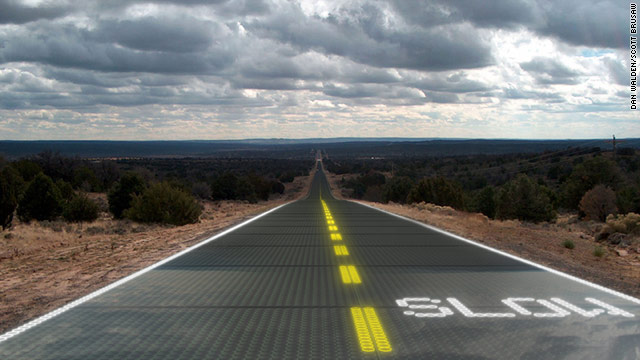 An artist's conception of engineer Scott Bursaw's proposed solar roadway, which would resist ice and snow. America's harsh winters cost the nation's economy billions of dollars each year in snow removal equipment, weather damage to streets and vehicles, extra days of school and revenue lost to closed businesses. Scott Brusaw, a 53-year-old electrical engineer in tiny Sagle, Idaho, thinks he has a solution. So far, he's generated interest from the federal government and General Electric in his idea for a solar-powered roadway made from super-strong glass, instead of conventional asphalt or concrete. "I'm looking out the window now at about a foot of snow, so if we can make it work here, we can make it work anywhere in the country," Brusaw said. "I'm hoping this spring we'll start laying the foundation for it right outside our building here." Solar cells inside its glass surface would allow the roadway to act as a giant solar power generator, fueling embedded heating elements and making plows and other snow removal equipment unnecessary. The heating elements would work "like in the rear window of your car," said the inventor, who intends to experiment with temperature settings during the next stages of the development process. Electricity generated by the highway could be used to recharge electric vehicles and to power lights and LED warning signs along the road itself. In fact, Brusaw believes that solar roadways -- if widely accepted -- could eventually generate clean electricity around the world, eliminating the need for fossil fuels and saving the planet from global climate change. Marrying pavements with buildings Brusaw is not alone in his quest to build a smarter road surface. On the other side of the country, at Massachusetts' Worcester Polytechnic Institute, civil engineer Rajib Mallick has a vision of his own. 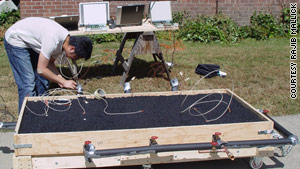 Worcester Polytechnic Institute is trying to tap into the energy potential of asphalt. One idea is to embed the pavement with half-inch pipes filled with a fluid that resists freezing. In warmer weather, sun-heated fluid is stored in an insulated chamber, where it stays hot. Then, in cold weather when it's needed, that hot fluid is sent through the pipes to melt ice and snow. "Think about it, we have more than 3 million miles of highways exposed to sunlight, so if we can harness this energy, it's free, and you don't need photovoltaic solar cells," said Mallick. In the summer, the system could link parking lots to adjacent buildings, Mallick said, transferring heat from the asphalt to water tanks in adjacent buildings, which would save electricity. 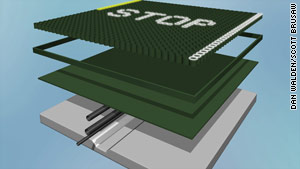 Solar road panels would include glass layers, solar power cells, heating elements and LED road markers. Even a warm weather city like Miami, Florida, could benefit from temperature-regulated pavements. The Worcester project estimates that every 50 meters of pipe embedded in Miami pavement would cost $12,500 to construct, $1,000 a year to maintain and would yield enough annual energy from its heat to power 55 homes for a month. In six years, the smart pavement would pay for itself in energy production and savings, according to research by Mallick and his colleagues. Smart pavements offer potentially impressive savings in other ways. Alaska spends an estimated $1,600 per mile on annual repairs to ruts in roadways. Controlling the pavement temperature can prevent much of this rutting damage, Mallick said. Three FAQs that Brusaw gets For Brusaw, the biggest opposition so far can be summed up in a word: "Change," he said. "It scares people, I think." -- How can glass provide enough traction while supporting the weight, wear and tear of a conventional concrete or asphalt highway? Glass, especially when fused together in layers, is stronger than most people think, said Brusaw. He said he's joined forces with top glass researchers at University of Dayton and Penn State who can develop super-strong glass that would offer vehicles the traction they need. -- How much would the solar highway cost? Brusaw calculates an estimated cost -- in great detail -- on his website. Short answer: each mile would cost $4.4 million. Payoff? A cleaner, self-sustaining highway that would eventually pay for itself in energy production and in other ways, he said. -- Can the solar highway's surface collect enough sunlight when it's filled with bumper-to-bumper traffic? Yes, he says. Even when roadways are filled with bumper-to-bumper traffic, solar collection would be at 50 percent, he estimates. Federal, state support Building and maintaining "better, faster and smarter" roads to improve safety, increase taxpayer value and to remain competitive in the global economy are some of the reasons behind the Federal Highway Administration's commitment to innovation, said agency Administrator Victor Mendez. The FHWA gave Brusaw a $100,000 contract and the agency is supporting other smart road research across the nation. Virginia Tech is looking at using machines called piezoelectric generators to convert the weight of truck traffic on pavements into energy that powers nearby lighting signals. Another FHWA program at the University of Nebraska Lincoln will research how hybrid solar- and wind-based generators positioned along roadsides can power highway infrastructure -- and even send extra electricity to nearby communities. However -- after ideas like these are perfected in laboratories -- the financial and political pathway to the real world will be tricky when state and federal budgets are severely limited, said Robert E. Lang, director of University of Nevada Las Vegas' Brookings Mountain West think tank. "There aren't a lot of revenue sources to pay for this," said Lang. Justifying the cost of installing anti-snow smart roads would be easiest in areas of high population density, Lang said, where vehicles could be charged fees for the right to use them. As for Brusaw, he hopes to win more private and federal support by demonstrating a new prototype smart-road parking lot to be finished in the spring. His goal would be to partner with a high-profile national chain like McDonald's or Walmart to turn their conventional parking lots into solar-powered, interactive, temperature-controlled spaces where electric-vehicle owners can recharge their cars while they shop or drive across the country. "The Federal Highway Administration told us they're not going to let us go out on the highway to start this," said Brusaw. "They told us to go into the parking lot first, prove your technology, perfect it and learn your lessons there -- which makes sense." Source: cnn |
Thursday, January 20, 2011
Solar-powered 'smart' roads could zap snow, ice


Thursday, January 13, 2011
You Can Win $50,000 In Google's Global Science Fair
The science fair! I don't think any of my schools ever had one, but according to the movies they are a bonafide rite of passage for young nerds everywhere. Now, Google's hosting one with a $50,000 grand prize.
The Google Global Science Fair 2011, a competition for kids aged 13 to 18, hopes to find "budding Einsteins and Curies," brilliant young minds who are already interested in working out today's pressing science problems. Entries are to be submitted online with a Google Site accompanied by a 2 minute video. You can read about all those details here.
 And the prizes! Oh the prizes. The Grand Prize winner will get to go on a National Geographic expedition to the Galapagos Islands—maybe they'll be the next Darwin!—as well as a $50,000 scholarship, some sort of internship or something at their choice of CERN, Google, LEGO, or Scientific American, and—and!—a LEGO mosaic of their likeness. Paper mache volcanoes at the ready! [Google Global Science Fair]
Source: gizmodo
The Google Global Science Fair 2011, a competition for kids aged 13 to 18, hopes to find "budding Einsteins and Curies," brilliant young minds who are already interested in working out today's pressing science problems. Entries are to be submitted online with a Google Site accompanied by a 2 minute video. You can read about all those details here.
And the prizes! Oh the prizes. The Grand Prize winner will get to go on a National Geographic expedition to the Galapagos Islands—maybe they'll be the next Darwin!—as well as a $50,000 scholarship, some sort of internship or something at their choice of CERN, Google, LEGO, or Scientific American, and—and!—a LEGO mosaic of their likeness. Paper mache volcanoes at the ready! [Google Global Science Fair]Source: gizmodo
Wednesday, January 12, 2011
Verizon iPads finally ditch MiFi cards for real connectivity
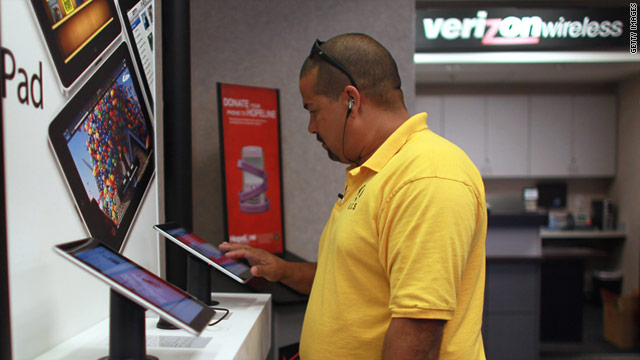
Heriberto Cazanas checks out the iPads on display at a Verizon store in Coral Gables, Florida.
Along with hearing the announcement about the Verizon iPhone Tuesday, we've learned that Apple's iPad -- which has been marketed by Verizon for some time -- will now actually be able to connect directly to the Verizon network. We realize that connecting the device to the network sounds like a no-brainer.
However, for the past few months, folks with Verizon iPads have had to buy separate external Verizon MiFi devices in order to connect when Wi-Fi wasn't available. Now, as Apple's exclusivity with AT&T comes to a close, the iPad will be able to connect directly to Verizon's 3G -- and who knows, perhaps even its 4G LTE -- network.
The latter would bring it to parity with Motorola's Xoom, a new Android-powered tablet recently announced at CES. iPads with embedded Verizon chips will be coming soon; however, an exact release date hasn't yet been set.
The iPad first came to Verizon in October 2010. Although connecting to the network when Wi-Fi wasn't present did require a bundled MiFi, costs were comparable and data plans were better than what AT&T customers were getting.
Source: cnn
World's First Electric Supercar Taking Pre-Orders and Going Into Production
 The Li-Ion Inizio holds the distinction of being one of the first all-electric supercars. It can hit speed up to 170 MPH and with a range of 250 miles. Now it's going into production and can be yours for $139,000.
Li-Ion won 2.5 million dollars in the the 2010 Automotive X-Prize for their work on their Wave II vehicle. Now, according to Gizmag, they're using the money to bring the Wave II and the Inzio to market. The Inizio has three models for sale at $139,000, $189,000 and $249,000, with the fastest Inizio model going from 0-60 in 3.4 seconds. It uses 12 batteries, comes equipped with two motors and charges in 8 hours.

The less able Wave II will sell for 39,000 and 49,000, with the more expensive model able to travel 200 miles on a single, seven-hour charge. Pre-orders for both cars will begin this month. If all goes to plan, the Inizio should begin shipping in July 2011, and the Wave II will arrive in December 2011.
Source: gizmodo
Wednesday, January 5, 2011
Samsung's 9 Series Laptop Takes the MacBook Air Head-On

It looks like the 13-inch MacBook Air finally has some serious competition: the 13-inch Samsung 9 Series is a shade lighter, a touch thinner, and looks like the Air's evil twin.
The differences in size and weight may amount to not much more than a rounding error—2.89 pounds to the Air's 2.9, and profiles of .64 inches versus .68—but its black metal finish and sleek curves make it look like it belongs on the deck of the Death Star.
The 9 Series packs a 1.4GHz second-gen Core i5 processor, including Intel's much-improved integrated graphics, and claims a downright decent 6.5 hours of battery life. You're also looking at 4GB RAM, a 128GB SSD, and a, surprisingly for the frame, a 1.5watt subwoofer. Gilding this very thin lily are USB 3.0 and built-in WiMax 4G. It's a wicked katana.
Which, of course, is going to cost you. The 9 Series comes this February with a $1600 starting price. But hey—good looks and strong guts never come cheap.
Key Specs:
· CPU: Second Generation Intel® CoreTM i5 Processor 2537M (1.40 GHz, 3MB; turbo up to 2.3 GHz)
· Operating System: Genuine Windows® 7 Home Premium (64 bit) / Windows® 7 Professional (64 bit)
· Memory: 4GB DDR3
· Storage (max): 128GB Solid State Drive (SSD)
· Screen: 13.3-inch HD LED-backlit SuperBright Plus display (400 nit)
· Resolution: 1366x768
· Graphics: Intel HD GT2 Integrated Graphics
· Speakers: 3 watt (1.5W x 2) stereo speakers and 1.5 watt sub-woofer
· Battery: Lithium Polymer; up to 6.5 hours
· Wireless: 802.11b/g/n; WiMaxi
· Weight: 2.89 lbs.
Source: gizmodo
Subscribe to:
Comments (Atom)